
Home > INDUSTRIES > Solution >



How to Choose a Dust Collector for Cotton Mills?
Cotton mills generate a large amount of cotton dust during production (such as cotton opening, carding, drawing, spinning processes). Cotton dust has the characteristics of light weight, small particle size (≤5μm), easy floating, flammability and certain viscosity. The selection of dust collectors for cotton mills should focus on high efficiency, anti-static, anti-blockage and safety, and the key selection points are as follows:
First, determine the dust removal type according to the process and dust generation point. Cotton mills mainly adopt two types of dust removal: local dust removal and centralized dust removal. 1. Local dust removal: Install local dust collection hoods near each dust generation point (such as cotton opening machine, carding machine), and match with small pulse bag dust collectors or mobile dust collectors. It has the advantages of targeted dust collection, energy saving and convenient maintenance, suitable for small and medium-sized cotton mills or single equipment. 2. Centralized dust removal: Adopt a centralized pulse bag dust collector, connect all dust generation points through pipelines, and uniformly collect and purify cotton dust. It is suitable for large-scale cotton mills with multiple production lines, which can realize unified management and good dust removal effect.
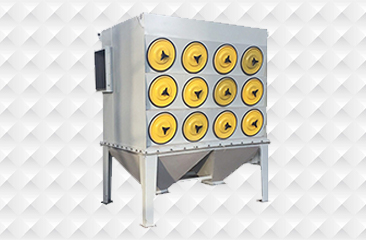
Second, select the core dust collector type: Pulse bag filter is the first choice for cotton mills, which has the following advantages: high dust removal efficiency (≥99.9%), can capture ultra-fine cotton dust; flexible air volume adjustment, can be matched according to the dust generation; the filter bag is easy to replace and maintain; it can be equipped with anti-static measures to avoid static accumulation and fire hazards. It should be noted that cyclone dust collectors are not suitable for cotton mills, because their dust removal efficiency is low (only 85-90%), and it is difficult to capture fine cotton dust, which cannot meet the environmental protection standard.
Third, key supporting requirements. 1. Anti-static measures: Cotton dust is flammable, and static accumulation is easy to cause fire and explosion. The dust collector must be equipped with anti-static devices: the filter bag adopts anti-static needle felt (surface resistance 10⁶-10⁹Ω), the equipment body is grounded (grounding resistance ≤4Ω), and anti-static pipelines are used. 2. Anti-blockage measures: Cotton dust has certain viscosity, which is easy to adhere to the filter bag and cause blockage. The filter bag should be selected with water-repellent and oil-repellent coating (such as polyester anti-static water-repellent oil-repellent needle felt); the pulse cleaning system should be optimized, with appropriate cleaning frequency (30-60s/time) and spray pressure (0.4-0.5MPa) to ensure thorough cleaning. 3. Safety devices: Install explosion-proof valves and pressure relief devices on the dust collector to prevent fire and explosion accidents; the ash hopper is equipped with a level gauge to timely discharge cotton dust and avoid dust accumulation.
Fourth, match the air volume and pressure. The air volume of the dust collector should be 10-20% higher than the actual dust generation air volume of the cotton mill. For example, a single carding machine needs an air volume of 2000-4000m³/h, and a large-scale cotton mill with 10 carding machines needs an air volume of 20000-40000m³/h. The static pressure of the fan should overcome the system resistance (filter bag resistance + pipeline resistance), and reserve 10-15% of the margin to ensure stable operation.
Fifth, consider energy consumption and maintenance. Choose high-efficiency fans (energy efficiency grade 1 or 2) to reduce long-term operating costs; the filter bag should have a long service life (preferably 1-2 years) to reduce replacement frequency and maintenance workload; the dust collector should have a simple structure, convenient maintenance, and adapt to the long-term continuous operation of cotton mills.
Xinxiang Lefilter Filter Co., Ltd All rights reserved Record No. : 11005909-1 prepared by Yu ICP


 +86 185 6822 9226
  enquiry@xxfilter.com